
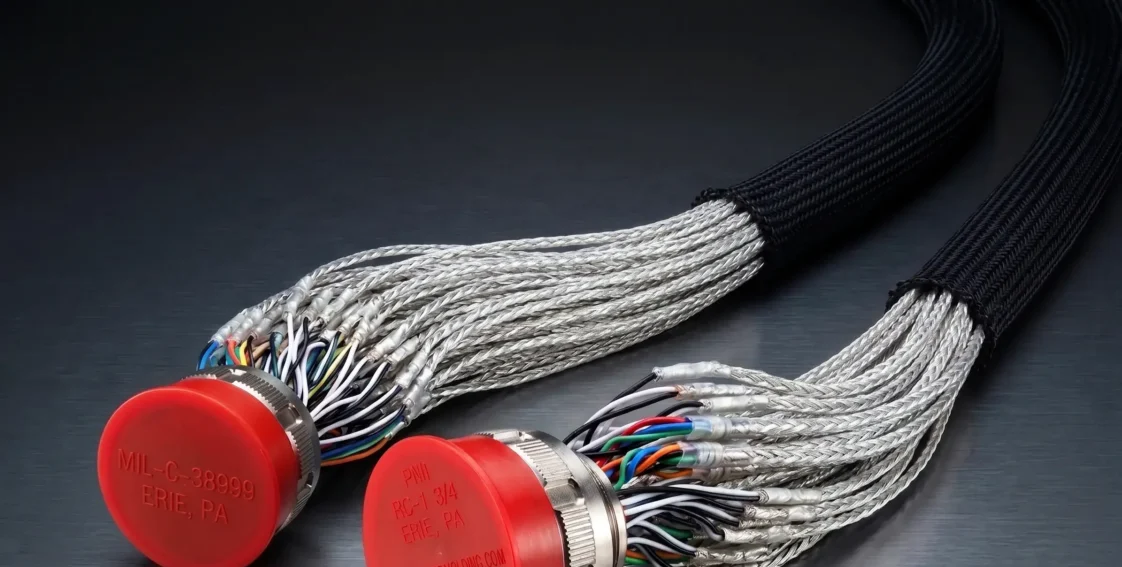
Cable assemblies serve as the data communication system of complex aerospace and defense machinery. Choosing the right manufacturing partner for these assemblies is crucial. Aerospace and defense companies are required to find a partner that understands:
- Electromagnetic interference (EMI) must be avoided at all costs to ensure safety and accuracy of equipment
- Precision assembly, rigorous documentation, and uncompromising quality control are essential
- Industry standards including IPC and ITAR
When a leading aerospace and defense manufacturer needed a partner for cable assemblies, they turned to PGF Tech to provide the quality and documentation necessary to ensure the safety and accuracy of their equipment. Here’s how PGF Tech helped the manufacturer ensure unsurpassed quality with each assembly.
Situation

EMI can significantly impact the performance of defense equipment. In high-stakes aerospace and military environments, signal degradation or unintended electrical noise can cause inaccuracies, communication failures, or equipment malfunction. This can put the users’ safety at risk.
Every electronic component must be assembled precisely to specification in order to mitigate safety risks. Shielding integrity, grounding continuity, torque accuracy, and terminal retention all directly influence system reliability. Only some assembly partners are equipped to operate with this level of care.
A major aerospace and defense manufacturer required a partner capable of delivering defense-grade cable assemblies with measurable, verifiable quality controls built into every step.
Task
The manufacturer’s objectives were to:
- Build defense-grade cable assemblies that prevent electromagnetic interference
- Measure and document each step of the assembly process to meet regulatory and customer standards
- Guarantee repeatability and reproducibility across production runs and operators
Action
PGF Tech implemented a highly controlled, documentation-driven assembly process designed specifically to meet the customer’s needs, industry standards, and PGF’s internal quality metrics.
Complex Cable Assembly
Each cable assembly consisted of up to 80+ individual cables, with 2–3 wires per cable. Every cable was individually stripped and integrated with shielding into the larger cable structure. Providing shielding at the individual cable level adds an additional layer of protection that meets industry practices in aerospace and defense applications.
Shielding & Grounding Integrity
Part of the assembly process is the installation of any back shells. PGF Tech carefully measured and controlled the exact amount of torque required to twist on the back shell securely, ensuring compliance with the customer’s specifications.
The process is critical:

- The shielding from each cable assembly was brought into contact with the metal back shell
- The back shell served as a grounding point
- This grounding path prevented EMI by safely dissipating electrical noise
Many connectors also have a clamp which secures the connector on the cables as a stress relief. In addition, all screws and hardware were torque measured. Precise torque measurement ensures consistent grounding contact without damaging components. This is a key factor in long-term reliability.
First Article Validation
First article builds help our team ensure that the cable is being assembled to fit customer specifications, industry standards, and PGF Tech’s internal quality metrics. PGF Tech completed a first article build for the customer’s cable assembly project when:
- A new design was introduced
- A new manufacturing process (tooling, machinery, equipment, etc.) was applied
In addition to completing a first article build, a control plan document was created. This document laid out each part of the assembly process for the assembly team.
This first article process and control plan confirmed:
- Each assembler was fully trained on how to build the customer’s design
- All shielding and grounding steps were executed correctly
- The cable could be manufactured with consistent repeatability and reproducibility
Full Process Documentation
Every critical step in the assembly process was measured, verified, and recorded on the control plan. This includes torque measurements, shielding verification, grounding confirmation, and inspection checkpoints.
Results
Through precision engineering and disciplined documentation, PGF Tech delivered cable assemblies that meet:

- Customer-specific defense requirements
- Internal PGF Tech quality standards
- IPC/WHMAA-A-620 standards
- ITAR compliance requirements
- ISO 9001 quality management standards
PGF Tech delivered each cable assembly with detailed test records, ensuring the cable assembly met all necessary specifications. The customer received a fully documented, defense-grade cable assembly engineered to maintain accuracy and safety in mission-critical aerospace and defense equipment.
When tolerance for electromagnetic interference is zero, process control, precision assembly, and documented accountability make the difference. If your assembly project requires a higher level of care, contact PGF Tech today to begin your project: https://www.pgftech.com/contact-us/
FAQs
How does PGF Tech ensure quality of aerospace cable assemblies?
On each cable assembly, the PGF Tech team performs pull testing and visual inspections during the assembly process. At the end of the assembly, testing for connectivity is completed. Throughout the assembly process, our expert team ensures that all IPC standards for the particular class are met.
What is shielding and why is it necessary for aerospace cable assemblies?
Shielding prevents electromagnetic interference (EMI) from disrupting the electrical currents in the cable. EMI can interrupt signals, cause data loss, and compromise the cable’s reliability. Shielding helps prevent EMI, maintaining the accuracy and safety of the cable when in use.
What does the first article/control plan creation process look like?
A first article build is assembled by PGF Tech. During this process, a control plan is created that lays out each step in the assembly process for the particular project. Once the first article and control plan are completed, the customer has the ability to review and approve both. PGF Tech then adapts the control plan as needed to meet the customer specifications.
