


Printed circuit board assemblies (PCBAs) power nearly every modern electronic device, including medical devices, aircrafts, automation robotics, data center infrastructure, and more. As electronics become more complex and production demands increase, manufacturers need assembly processes that deliver speed, consistency, and precision.
That’s where automation in PCB assembly becomes essential.
For companies requiring reliable, repeatable, and scalable production, automated equipment plays a major role in maintaining quality while reducing variation and manufacturing errors. Whether producing prototypes or high-volume builds, automation helps a PCB assembly company deliver dependable results.
Throughout this guide, we will dive deeper into:
- Why automation practices and equipment are important to production
- Different automation equipment to keep an eye out for when choosing a partner
- How to choose a PCBA partner with automation capabilities
Why Use Automation in PCB Assembly?
Automation Supports Repeatable Manufacturing
One of the biggest advantages of automation in PCB assembly is repeatability.
Consistency is always critical when it comes to PCBAs, and it is especially important when a PCB assembly moves from prototype to higher production quantities. Using only manual assembly methods can introduce variability between builds, particularly when production volumes increase.
Automated manufacturing equipment allows PCBAs to be produced repeatedly using the same programmed process, machine settings, and placement parameters. This helps ensure that every board is assembled to exact customer specifications across production runs.
For customers producing larger quantities of assemblies, repeatable manufacturing can help improve:
- Product consistency
- Quality control
- Production scalability
- Manufacturing efficiency
- Process reliability
This repeatability is especially important in industries such as aerospace, defense, and medical where precision and consistency are essential.
Automation Improves Component Placement Accuracy
Modern PCBAs often contain extremely small, densely populated components that require precise positioning.
Automated surface-mount technology (SMT) machinery significantly improves component placement accuracy by using robotics, software programming, vision systems, and inspection technology to place components exactly where they belong.
Compared to manual placement, automation helps reduce risks such as:
- Misaligned components
- Missing components
- Incorrect polarity orientation
- Solder defects
- Placement inconsistencies
The result is a more accurate, reliable, and higher-quality assembly process.
Machinery to Look for in an Automated PCB Assembly Process
When evaluating a PCB assembly company, it’s important to understand the manufacturing equipment supporting its production capabilities. The right automated machinery can directly impact assembly quality, inspection accuracy, and throughput.
Below are several key technologies commonly found in automated PCBA manufacturing environments.
What is a DEK Screen Printer?
The assembly process typically begins with solder paste application.
A DEK Screen Printer applies solder paste to the raw printed circuit board before component placement. Using a stencil and
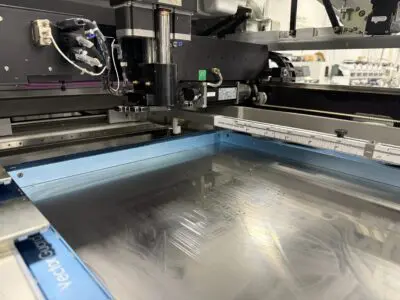
controlled printing process, the machine deposits solder paste precisely onto designated pads for surface-mount components.
Accurate solder paste printing is critical because it directly affects solder joint quality later in the assembly process.
Benefits of automated screen printing include:
- Consistent solder paste volume
- Improved print accuracy
- Reduced manufacturing variability
- Better SMT process control
What is a CyberOptics SPI (Solder Paste Inspection)?
After solder paste printing, manufacturers often verify print quality using Solder Paste Inspection (SPI) technology.
A CyberOptics SPI system is an automated optical inspection tool used to examine the quality of solder paste deposited on the PCB.
The system checks factors such as:
- Paste height
- Paste volume
- Paste alignment
- Deposit consistency
Identifying solder paste issues early in the process helps prevent downstream defects, reducing rework and improving overall assembly quality.
What are MyData My100SXE, FUJI NXTIII & XPF-W Pick and Place Machines?
After solder paste is applied and inspected, it is time to place the electronic components onto the PCB. To do so, pick and place equipment is at the core of automated SMT PCB assembly.

Machines such as the MyData My100SXE and FUJI NXTIII & XPF-W systems are designed to automatically pick electronic components from feeders and accurately place them onto solder-pasted circuit boards.
These machines handle components including:
- Resistors
- Capacitors
- Integrated Circuits (ICs)
- Connectors
- Other SMT devices
Automated pick and place technology offers several advantages:
- High-speed production
- Precise component positioning
- Consistent assembly quality
- Support for complex PCB designs
For assemblies with fine-pitch, miniature, or densely populated layouts, automated placement equipment is especially valuable.
What is a BTU International Reflow Oven?
Once components are placed, the board moves into the soldering stage.
A BTU International Reflow Oven heats the assembly according to a controlled temperature profile, allowing solder paste to melt and create permanent electrical and mechanical connections between components and the PCB.
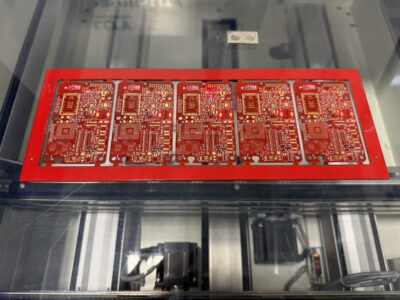
Controlled reflow soldering is critical for achieving reliable solder joints.
Automated reflow ovens help manufacturers maintain:
- Consistent thermal profiles
- Uniform solder quality
- Reduced soldering defects
- Repeatable process control
Without properly controlled reflow processes, manufacturers can encounter issues such as cold joints, insufficient soldering, or component damage.
What is a CyberOptics AOI (Automated Optical Inspection)?
Inspection is another crucial step in automated PCB assembly manufacturing.
Automated Optical Inspection (AOI) systems, such as CyberOptics AOI, automatically inspect completed assemblies for visible manufacturing defects.
AOI technology can detect issues including:
- Missing components
- Incorrect component placement
- Solder bridges
- Polarity errors
- Alignment defects
AOI systems help identify issues with assembly quickly. This practice, paired with manual inspection, helps manufacturers improve quality assurance with larger scale assembly projects.
Choosing a PCB Assembly Company with Automated Capabilities
When selecting a PCB assembly company, it is worth evaluating the equipment, inspection processes, and automation technologies used throughout the production line to ensure consistent quality PCBAs.
A couple of tips to consider when evaluating a PCBA partner: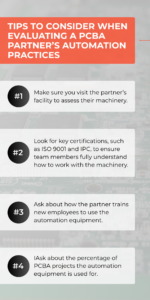
- Make sure you visit the partner’s facility to assess their machinery.
- Look for key certifications, such as ISO 9001 and IPC, to ensure team members fully understand how to work with the machinery.
- Ask about how the partner trains new employees to use the automation equipment.
These tips will help give you a better understanding of how proficient the team is in the PCBA automation equipment. This will help you ensure the equipment is at the partner’s facility and being used to its fullest potential.
A manufacturer investing in automated systems often demonstrates a commitment to producing a quality PCB assembly each time and to scaling up production with its partners.
Automation, paired with engineering expertise and skilled operators, enhances operations by providing the tools needed to manufacture complex PCBAs with greater accuracy and repeatability.
Automation has become a fundamental part of the modern PCB assembly process. Advanced automation equipment helps manufacturers produce PCBAs with improved consistency, precision, and efficiency throughout each step of the manufacturing process.
For companies seeking a dependable PCB assembly partner, understanding a manufacturer’s automation capabilities can provide valuable insight into its ability to support quality, scalability, and long-term production success.
If you’re looking for a PCBA partner that can deliver quality PCBAs consistently as your operations scale, look no further than PGF Tech. Contact us today to learn more: https://www.pgftech.com/contact-us/