
On the manufacturing plant floor, every second counts.
Downtime is often a manufacturing plant’s most costly problem, so industrial automation equipment must be built to last. That includes every component inside that equipment, especially the PCBAs.
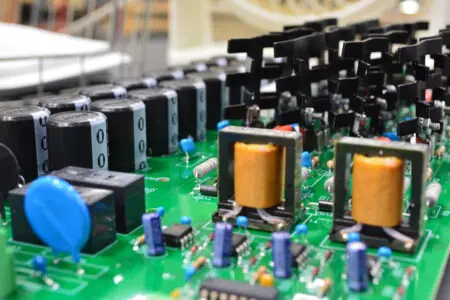
Behind every robotic arm, control panel, and safety system on the floor is a Printed Circuit Board Assembly (PCBA) working to keep production moving. Let’s take a deeper look at how PCBAs power industrial automation equipment for years of reliable service.
PCBA Applications in Industrial Automation
A single manufacturing plant can rely on tens of thousands of PCBAs. These boards act as the nervous system of the machinery, sending the signals that drive everything from a robotic weld to an emergency stop. Let’s walk through the many places within a manufacturing plant’s automation equipment in which PCBAs show up.
Robotics and Motion Control
Robotic arms and motion systems depend on PCBAs to translate commands into precise, repeatable movement. Servo drives and motor controllers use these boards to manage speed, torque, and positioning in real time, often down to fractions of a millimeter.
On a production line, that level of precision is what keeps parts aligned, welds consistent, and cycle times predictable. On an automotive plant’s body shop line, welding robots rely on this precision to place thousands of consistent spot welds on every vehicle body that moves down the line.
PLCs and Control Panels
PLCs are the decision-makers of the plant floor, and PCBAs are what give them the ability to think and communicate. CPU boards, I/O modules, and communication interfaces all work together inside a control panel to monitor conditions and trigger the right response.
These boards are constantly processing input from across the line and translating it into action. In a food and beverage plant, a PLC manages a pasteurizer’s diversion valve, automatically rerouting any product that hasn’t reached the required temperature instead of letting it continue to packaging.
Sensing and Feedback Systems
Sensors, encoders, and vision systems generate a steady stream of real-time data on position, speed, quality, and part presence. PCBAs inside these devices condition and transmit that data back to the control system, giving operators and machines the information they need to catch issues before they become costly ones.
In aerospace and defense manufacturing, vision inspection systems use this real-time feedback to catch microscopic defects in machined components before they’re cleared for assembly.
Safety and Power Systems
Safety relays, emergency-stop circuits, and power distribution boards protect both equipment and the people working alongside it. These PCBAs are designed with redundancy in mind, so a single point of failure remains an isolated incident instead of compromising the safety of the whole system.
In a data center, redundant power distribution boards keep critical systems running on backup power the moment a primary source fails, preventing a single fault from taking servers offline.
Key Considerations for PCBAs in Industrial Automation
PCBAs have countless adaptations within the industrial automation space. Due to their versatility, PCBAs must be assembled with the utmost care. It is important to keep the following considerations in mind when building PCBAs to promote uptime and longevity.
Testing is non-negotiable for preventing downtime
Quality must be built into every step of assembly:
- After applying solder paste, it is important to use a Solder Paste Inspection (SPI) machine to ensure the paste is applied correctly.
- After SMT and soldering, each component should be manually inspected for proper placement, then run through an Automated Optical Inspection (AOI) machine.
- Final testing confirms the board will perform as expected once it’s installed and running.
Catching an issue on the bench is a quick fix. Catching it after installation can mean hours or days of costly downtime.
Smart component sourcing and obsolescence management
Industrial automation equipment often stays in service for well over a decade, but the electronic components inside it can reach end-of-life in a fraction of that time. Without a sourcing strategy in place, a single discontinued component can leave a plant waiting weeks for a redesign or last-time-buy stock.
Maintaining an accurate Approved Vendor List, planning ahead for last-time-buy components, and choosing industrial-grade parts with longer production lifecycles all help keep replacement boards available when they’re needed most.
Working with an assembly partner that can give component obsolescence management strategies can help alleviate some of the responsibility from internal teams.
Design for longevity and durability
Plant floors are demanding environments: vibration, temperature swings, dust, and electromagnetic interference from nearby motors are constant threats to a machine’s performance. A PCBA designed only for lab conditions can fail once it hits the floor.
Conformal coating, components rated for extended temperature ranges, proper thermal management, and ruggedized connectors all help a PCBA hold up to the conditions it will actually face rather than only the conditions it was tested in.
Working with a partner that provides Design for Manufacturability services and has experience in industrial automation can help you account for these factors at the design stage.
PCBAs hold critical roles in industrial automation: guiding robotic precision, powering control systems, feeding real-time data, and protecting the people and equipment on the line. Built with the right testing, sourcing strategy, and durability in mind, these boards are what keep production running day after day, and even year after year.
If your industrial automation equipment depends on reliable electronics, working with an experienced PCBA partner like PGF Tech can make all the difference. Learn how precision assembly, rigorous testing, and a commitment to quality help keep your production line running: Contact Us | PGF Technology Group