
When submitting an electronic assembly project to a contract manufacturer, it is important that you include two key documents: an engineering drawing and a BOM.
A Bill of Materials, or BOM, is crucial to the success of your electronic assembly. It ensures quality, sets lead times, determines assembly pricing, and maintains consistency among builds.
In this guide, we will go over the ins and outs of BOMs: what a BOM is, how to create one, common BOM mistakes, and more. Let’s begin with the basics: What is a BOM?
BOM Basics
A BOM, short for Bill of Materials, is a list of all the materials needed to create an electronic assembly. A BOM should include the following at the least:
- Each component’s name
- The manufacturer of each component
- The manufacturer’s part number
It is also best practice to include if substitutions for each component are okay.
It is important to provide your electronic assembly partner with a BOM for several reasons. BOMs ensure consistency and quality among all assemblies with a design. When an electronic assembly partner receives a well-structured BOM, they can ensure they are purchasing and receiving the same parts for each assembly. This helps to create all assemblies under the design the same and ensures that the quality of each individual assembly will remain the same as the others.
BOM Best Practices
So, how do we make a well-structured BOM? To make your BOM as useful to your electronic assembly partner as possible, it is important to follow these tips:
- Include the manufacturer and manufacturer part numbers (MPNs) for each component to ensure your electronic assembly partner is purchasing and receives the exact part needed.
- Keep each unique component on its own line within your BOM spreadsheet to avoid missing components.
- Indicate if you are willing to accept substitute components in your BOM. This can help your partner find solutions for inflated costs, long lead times, obsolete components, and more.
Common BOM Mistakes
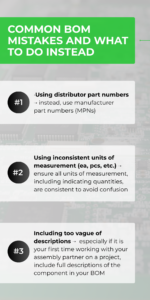
Some common mistakes when creating a BOM can include:
- Using distributor part numbers à instead, use manufacturer part numbers (MPNs)
- Using inconsistent units of measurement (ea, pcs, etc.) à ensure all units of measurement, including indicating quantities, are consistent to avoid confusion
- Including too vague of descriptions à especially if it is your first time working with your assembly partner on a project, include full descriptions of the component in your BOM
BOMs are an integral part of the electronic assembly process. Taking the time up-front to create a well-structured BOM will allow your electronic assembly partner to maintain quality and consistency across builds, especially if this is your first time working with a partner on a cable assembly, wire harness assembly, PCB assembly, or box build.
Want more information on how to create the best BOMs? Contact us today, and our sales team would be happy to help you assess your electronic assembly’s BOM: https://www.pgftech.com/contact-us/
FAQs
What is a BOM?
A BOM, short for Bill of Materials, is a list of all the materials needed to create an electronic assembly. It should include every component that goes into your electronic assembly.
Why do I need to provide a BOM?
Providing a BOM is one piece to giving your electronic assembly partner the exact specifications that you need your project built to. Well-structured BOMs ensure quality, set lead times, determine assembly pricing, and maintain consistency among builds.
What should be included in my BOM?
A BOM should include the following at the least:
- Each component’s name
- The manufacturer of each component
- The manufacturer’s part number
It is also best practice to include if substitutions for each component are okay.