4 Huge Benefits of Selective Soldering

   |   By  |  0 Comments

Selective soldering is an important process in the assembly of Printed Circuit Board Assemblies (PCBAs). It is a method of soldering specific areas of a PCB rather than the entire board. This process improves the accuracy and quality of the soldering process and offers several benefits over traditional soldering methods.

The Process

Selective soldering is an amazing process that allows manufacturers to precisely and efficiently connect components on a circuit board. It’s a process that many people don’t know much about, but it’s an essential part of creating high-quality electronic devices.

The process itself involves using a machine to apply molten solder to specific points on a circuit board, connecting components together, and ensuring a strong and reliable electrical connection. The machine is controlled by a computer program, which allows for a high degree of accuracy and control, ensuring that each component is soldered correctly and securely.


Top Benefits of Selective Soldering:

1. Improves the accuracy and quality of the soldering process.

By soldering only specific areas of the PCB, this process reduces the risk of mistakes and defects. This can lead to higher quality final products and fewer rework or repair costs. Additionally, selective soldering allows for more precise control of the temperature and duration of the soldering process, which can prevent overheating of components and reduce the risk of defects.

2. Handles complex boards and components.

Selective soldering equipment is capable of soldering surface-mount and through-hole components, including components with odd geometries, and different sizes and shapes. This can be beneficial for companies that manufacture complex or advanced products that require specialized assembly processes.

3. Offers improved efficiency and productivity.

The process is faster and more accurate than traditional soldering methods, which can lead to improved turnaround times and reduced labor costs. Additionally, selective soldering has the ability to handle large volumes, which is especially beneficial for high-volume production runs.

4. Offers more flexibility than traditional soldering methods.

The process adapts to changing production requirements and can integrate easily into automated assembly lines. This can be beneficial for companies that need to adapt to changes in demand or market conditions quickly.


In conclusion, selective soldering is an important process in the assembly of Printed Circuit Board Assemblies (PCBAs) and offers several benefits over traditional soldering methods. Overall, it is a fantastic process that makes it possible to manufacture high-quality, reliable electronic devices. It’s precise, efficient, and cost-effective, making it a popular choice among manufacturers worldwide. So, if you’re looking to produce top-quality electronic devices, consider using selective soldering in your manufacturing process. It’s a surefire way to create happy and satisfied customers!

LinkedIn LogoYouTube LogoTwitter LogoFacebook Logo

6 Common Design Concerns with PCBAs

   |   By  |  0 Comments

Before PGF, There’s the Design

Designing a Printed Circuit Board Assembly (PCBA) can be a complex task, and engineers must take into account many concerns to ensure that the assembly functions correctly and meets all the requirements. These concerns include everything from the layout and routing of the circuits to the selection of components and materials. Before starting with the PGF partnership, a company must first solidify its design for the assembly process. 


1. Proper Routing

One of the most important design concerns in PCB Assembly is ensuring the proper routing of the circuits. This means that the pathways for electrical current are clear and free of any obstacles that could cause a short circuit or other problems. The routing of the circuits must also take into account the power requirements of the components, as well as any potential electromagnetic interference (EMI) that could affect the functioning of the assembly.


2. Layout of Components

Another important design concern is the layout of the components on the PCBA. Engineers must carefully consider the placement of the components to ensure easy assembly and enough space for them to function properly. The layout must also take into account the thermal characteristics of the components, as some components may generate more heat than others, and the layout should dissipate this heat effectively.


3. Component Selection

Component selection is also an important design concern. Chosen components must be appropriate for the application and compatible with the PCBA. This designation includes not only electronic components but also the materials used on PCBAs such as the substrate, copper thickness, solder mask, etc. Engineers should select them based on their specifications and characteristics, such as power dissipation and operating temperature range, and should be of good quality to ensure that they function correctly and have a long service life.


4. Safety and Compliance Requirements

The PCB Assembly must meet any necessary safety and compliance requirements. PCBAs in medical devices, for example, must meet stringent safety and performance standards set by certifications such as ISO 13485:2016. This includes ensuring that the materials and components in the assembly are safe for use in a medical environment and that the assembly is properly shielded to protect against electromagnetic interference. Similarly, PCBAs used in other applications such as industrial or aerospace must meet relevant compliance and safety standards.


5. Testing and Validation

Another important design concern is testing and validation of the PCB Assembly. The functionality of the PCB Assembly must be verified through various testing methods such as visual inspection, continuity testing, in-circuit testing, and functional testing to ensure that it meets the specifications and requirements of the application. Some machines to assist with the testing process include X-ray and AOI Inspection. This testing must happen at different stages of the assembly process to ensure the early detection and correction of any problems.


6. Cost

Finally, the cost is always a concern when designing a PCB Assembly. PCBAs can be expensive to manufacture, and the cost of components and materials can add up quickly. To minimize costs, the designer must consider the most cost-effective components and materials and use them in the assembly. Additionally, the design should be optimized to minimize the number of components and the size of the PCBA, while still meeting all the requirements.


Summary

In conclusion, designing a Printed Circuit Board Assembly involves many design concerns that need to be taken into account. Proper routing and layout of circuits, component selection, safety and compliance, testing and validation, and cost are key design concerns that engineers need to address to ensure that the PCB assembly functions correctly and meets all requirements. Skilled engineers and designers with experience in PCBA design and assembly can help to confirm functionality and feasibility before starting with your contract manufacturer. At PGF, you design it, and we’ll build it! 

LinkedIn LogoYouTube LogoTwitter LogoFacebook Logo

Question #6: CEO Success Series

   |   By  |  0 Comments

Question #6

Even the most competent organizations tend to face market competition. What are the strategies employed by you to thwart this competition? What, according to you, are the company’s key differentiating factors?

As in any large industry, PGF faces market competition in all aspects of its manufacturing services, from cable to PCB assembly. Naji Gebara employs his strong leadership skills and community-based strategy against all competition. The main differentiating factors include team unity, company transparency, and service capability. Employees utilize immense teamwork and advanced technologies with each project to meet customer specifications with high-quality products. Additionally, as a solutions provider, PGF maintains complete transparency with customers to ensure absolute satisfaction and a strong manufacturing relationship.

Unity

The most significant advantage held by PGF is the unity of our teams. From Naji’s ambition to move forward, he brings an entire team with him past the finish line. With the second core value noting that employees are treated as family, the encouragement of others can be found in every step of the process. With a spotlight on new market trends, our internal focus on our members’ preparedness shines through conversations with potential customers and suppliers. As one team, PGF can meet deadlines, produce quality work, and continue to grow.

CEO Success Series Question #6Transparency

For PGF, our vital differentiating factors include transparency and the need to provide solutions. In short, PGF is a solutions provider. We will give honest feedback to prospective and customer contacts. In order to move forward through any PGF project, customers are guaranteed all questions are answered swiftly and efficiently. Tracy McGraw, the Manufacturing Manager from Essen Bioscience, noted,

 “We sincerely appreciate your responsiveness and the way you conduct business…When placing an order with PGF, we received exceptional customer service with extensive product knowledge” (Tracy McGraw, Essen Bioscience).

This testimonial notes one instance of our dedication to customers in any project. Whether it be providing unique prototype services or additional steps for cable assembly, PGF is willing to adapt to the project at hand

Capability

Furthermore, a focus on well-rounded capabilities means that our facility handles printed circuit board, box build, and cable/wire harness assembly services. These new areas of expertise allow us to contribute that much more to our customers. Each service provided broadens the scope of the PGF future. Although market competition may be present, PGF allows customers to engage in multiple orders, services, and projects from a single and trustworthy company. The ability to produce high-volume orders showcases the strength of PGF and differentiates itself from other manufacturers within the industry. 

PGF Market Competition Strategy

The key to facing market competition is to compete with yourself first. As a practice that PGF stands for, fear not your competitor but your ability to perform. The PGF focus remains on increasing productivity, customer satisfaction, and raising internal expectations. Learn more about the selection of PGF capabilities and request a quote today!

LinkedIn LogoYouTube LogoTwitter LogoFacebook Logo

Box Build Assembly

   |   By  |  0 Comments

What is a Box Build Assembly?

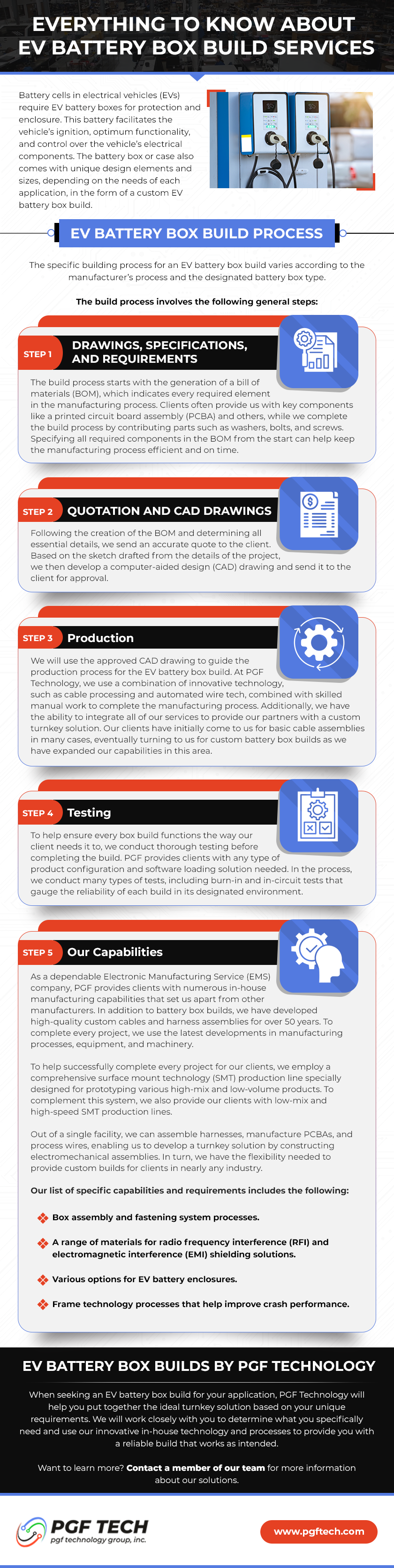
A box build assembly incorporates the manufacturing of both cables and printed circuit boards. Box builds consist of a single enclosure holding various complex electromechanical components. The combination of PCB and cable manufacturing involves a process involving intricate design, production, and construction for each unit. Additionally, box builds include an immense opportunity for customization in size, wiring specifications, and enclosure fabrication. PGF Technology Group offers a wide selection of enclosure types ranging from weatherproof to plastic materials. PGF dedicates itself to ensuring high-quality services and proper assemblies for each project and partner!

Box Build Applications

Box build assemblies are utilized in a variety of different industries and for a multitude of purposes. In practice, box builds have many integral applications in the advancing world of technology and electronics. Whether the box build is large or small, its importance to growing fields and daily conveniences continues to increase exponentially. From computers to industrial machines, each application demonstrates an industry seeking the capabilities of box-build assemblies for critical purposes. 

Box Build Assembly Infographic

Computer

The growing dependency on computers increases the demand for box builds. Complex software requires immense wiring connections and electrical systems for the highest performance quality.

Aerospace and Defense

The highly critical aerospace field requires error-free and trustworthy devices such as design-specific box builds. To ensure the utmost safety, the aerospace industry requires proper box build enclosures and reliable electronic processes. 

Industrial Machinery

The necessity for high productivity and performance distinguishes the need for box build industrial electronic devices. For protection purposes, the addition of PCBAs and wiring guarantees smooth operation in environmentally stressful conditions. 

Data Cable

A data cable box build is a common assembly that greatly varies from project to project. With the immense selection in size, such assemblies are customized based on their intended location. Typically, larger data cable assemblies are found in sizeable buildings. For example, skyscrapers, hotels, and even substantial homes generally hold data cable box builds.

Environmental Protection 

The box build structure differs from traditional assemblies in that the cables and printed circuit boards are protected through a physical barrier. Additionally, the entirety of the box build can be found within the external box aiding in the assembly process. Yet, in some instances, the barrier safely protects its components from extreme weather conditions, abrasion, physical destruction, and oil.

PGF Excellence

PGF’s cross-trained and qualified personnel provide efficient and high-quality box build assemblies. A PGF partnership benefits customers in the vast opportunity for customization as well as simplifying the supply chain assembly. With professional knowledge in box build assembly, PGF can lower production costs by accessing lower-priced components. Additionally, with both cable and PCB expertise PGF can provide box build services under a single warehouse, decreasing overhead costs. As for a simplified supply chain, PGF assembles box builds entirely in-house, thus removing potential conflict points for customers. PGF is a solutions provider relieving customers of the unnecessary stress of logistics and manufacturing. Request a quote today and learn more about the ways PGF can assist in all box build assembly needs!

LinkedIn LogoYouTube LogoTwitter LogoFacebook Logo

Question #5: CEO Success Series

   |   By  |  0 Comments

Question #5

What are the latest technologies enhancing the business that you have been proactively implementing? What will the PGF Technology Group’s future be?

With each release of the latest trusted technologies, PGF integrates machinery to advance high-quality assembly practices. At PGF, enhancing business translates to added technology throughout all assembly steps. For example, cable machines assist in wiring methods while PCB machines introduce more efficient PCB techniques. The future of PGF includes immense opportunities for growth with success both in monetary gain and individual development.

Edge of Technology 

The drive to constantly be on the edge of the next technological advancement is a PGF core value. PGF Technology Group is always utilizing the latest tools and practices.  Additionally, this drive comes from researching possible new industries of interest and prepping our facility to handle the most advanced projects. Across all PGF services, from cable assembly to prototyping, the company continues to integrate trusted technologies.  After all, if a company is not continuously growing, it falls behind.

CEO Series #5 infographicInvestment 

Yearly states of analysis give us the power to determine areas where improvement can bring the most progress. Everything starts with a plan and builds until it’s ready to be built again. This year, PGF is developing online training courses for new and tenured team members to deepen their skill sets and advance their careers – and PGF as a whole. The company has also digitized work instructions to create a more efficient assembly process, especially for new PGF members to accelerate their understanding of the procedures.

Additionally, we have updated our facility’s layout to increase resourcefulness and enhance workflow from concept to quality check to delivery. After all, a greatly flowing river becomes harder and harder to stop, just as PGF’s progress is becoming harder to slow down. A yearly investment of 2-5% of the annual budget goes toward machine updates. All in all, this facility update includes the universal usage of more automated tools over their manual counterparts, effectively improving assembly time and accuracy.  

The PGF Future

PGF can summarize its future in one word: Growth. Each team member‘s improvement works to bring new perspectives and opportunities to our partners. As CEO, Naji Gebara leads the company by lifting others while openly accepting constructive criticism as a means of progress. Adding internal employee skillset builder modules demonstrates PGF’s devotion to improvement. Overall, we expect to expand our services to include more design capabilities and extend our properties to continue expediting the assembly process. Learn more about PGF capabilities and request a quote today!

LinkedIn LogoYouTube LogoTwitter LogoFacebook Logo

Question #4: CEO Success Series

   |   By  |  0 Comments

Question #4

What is one of the biggest achievements of your organization owing to its revolutionary approach and your creativity? How does Naji Gebara deal with criticism as a leader?

The success of a CEO constitutes the biggest achievement of the organization as a whole. For Naji Gebara, success translated into the ability to take hold of as many opportunities as possible. Directly related to the PGF revolutionary approach and creativity, the best achievements lie in monetary gains and improved leadership. However, as with any position of authority, constant review and suggestions follow each decision. Yet, Naji Gebara takes constructive criticism openly, regarding each comment as an opportunity for growth.

Company Growth 

Since Naji Gebara’s complete acquisition of PGF, one of his most outstanding achievements has been doubling the business of this already well-established company. Year over year, double-digit growth rates show the outcome of hard work. However, this increase in PGF’s growth rate is not due to hard work alone. Every significant step of progress began as a vision that came to fruition. From daily overviews to weekly metrics, a data-driven company reveals the secrets to achievement. In other words, the numbers don’t lie, so use them to find the truth.  

Question #4 Infographic

Leadership 

This profit-driven advancement stems from a leader motivated by the thrill of the chase. Of course, money determines success outwardly, but internally, the anticipation for new opportunities determines longevity. With each achievement, Naji continues to assess the ways to improve as a leader to better work with others. Whether through open communication, in-depth meetings, or employee lunches, Naji takes the leadership responsibility seriously. As the company continues to grow, Naji’s leadership tactics grow alongside it.  

Improvement

Naji Gebara welcomes constructive criticism because it means the chance for improvement. As the common phrase in meetings, “If you disagree with me, please let me know,” suggests, he constantly seeks new perspectives from those around him. With each review, comment, and suggestion, Naji improves his approach to leadership. Beyond monetary measurements, comfort and individual achievements of PGF employees contribute to overall CEO success. Everyone has specific positions within PGF, but we are a team that benefits from each other’s suggestions and achievements. 

The PGF Difference

Naji Gebara actively leads PGF as a company with a purpose beyond monetary success and one of innovation and ambition. Customers are guaranteed high-quality products while supporting a company integrating advanced technologies for further improvement. From lifting other businesses to providing internal promotion and success exemplifies the PGF difference. Work with a company that values the success of others and request a quote today!

LinkedIn LogoYouTube LogoTwitter LogoFacebook Logo

Terminals Basics

   |   By  |  0 Comments

What is a Terminal?

Terminals are crucial components to any cable assembly process. By definition, a terminal is part of a class of electrical connectors used for the transfer of electrical currents from a grounding source or power. The terminal of a wire also indicates the point at which the conductor, from a component, device, or network, comes to an end. The multitude of cable applications introduces a wide selection of terminal variations and types. Each project consists of specified requirements that lead to the use of some terminals over others. PGF supplies customers will all kinds of terminals, effectively integrating the necessary parts for a successful cable assembly!

Variations

There are two main variations amongst cable terminals: insulated and non-insulated. Depending on the designated project, either one of the two variations is preferred for high quality product performance. Insulated provide an additional protective cover to avoid water and other moisture from getting to the wire. The insulation can be found in nylon, heat shrink, or vinyl material to act as a non-conductor wire. On the other hand, non-insulated are typically used in the instances in which the extra wire protection is not necessary. Additionally, the non-insulated wires are cheaper to manufacture, thus proving to be more economically valuable.

ring terminal

Terminal Types

Ring 

a round-ended terminal that easily allows a screw or stud to be attached. Ring Terminals are either crimped or soldered to the wire. Available in insulated or non-insulated.

Common Applications: Ring terminals are typically utilized within the automotive industry. The shape is ideal for connecting various contactors or mechanical relays to car engines and circuits.

fork terminal


Spade (Fork)

an open-ended spade terminal that is convenient to use allowing easy attachment or removal from the screw. Available in insulated or non-insulated.

Common Applications: Wire harness assembly projects commonly consist of tightly spaced installation spaces, thus mostly utilizing spade terminals. The spade provides reliable and quick electrical connections that are solderless.

hook terminal


Hook

a terminal convenient to use with an open end. Produced insulated or non-insulated, hook structures offer a simplistic yet durable connection for a variety of projects.

Common Applications: The simplistic hook design allows for easy-to use terminals that are durable and efficient. Thus, instances in need of electrical wire connectors are the most common hook terminal applications.

quick disconnect terminal


Quick-Disconnect 

A quick-disconnect terminal provides convenient and reliable use offering an easy connect and disconnect for two wires. Produced insulated or non-insulated.

Common Applications: Quick-disconnect terminals can be found in a multitude of auto, industrial, and consumer products. As one of the fastest ways to connect and disconnect two wires, such terminals are easily reusable and highly efficient.

bullet terminal


Bullet

Bullet terminals connect with the male and open-ended round female connectors creating a high-quality connection. The connection with bullet terminals helps prevent corrosion and other potentially harmful materials from entering a wire harness.

Common Applications: The automotive industry utilizes bullet terminals for quick and simple wiring connections. The bullet design provides durable connections that can be easily assembled and disassembled during manufacturing.

butt terminal


Butt

a Butt Terminal connects or terminates single or multiple wires. They help prevent abrasion and cutting. This extra protection helps keep out moisture, corrosion, and other negative elements. Butt Terminals serve as a simple solution to extend wires due to the ability to mate and connect wires.

Common Applications: Amongst various industries, butt terminals safely terminate any given wire. Additionally, another common use is to connect one wire to another.

flag terminal


Flag

 terminals that offer a convenient and secure connection. Flag terminals work well in tight spaces as well as when a quick-disconnect is too large. Provides a quick and easy connection and disconnect. Also available in insulated and non-insulated.

Common Applications: Flag terminals reliability promote their use for applications that require frequent connections.


PGF Terminal Services

Through the variety of industries and applications, PGF Technology Group, Inc. adheres to all customer project specifications and requirement. The company’s devotion to supreme quality, on-time delivery, and competitive industry pricing allows customers to trust PGF with all terminal needs. The wide range of manufacturing diversity within the company guarantees proper product assembly from highest expertise. Learn more about PGF capabilities and request a quote today!

LinkedIn LogoYouTube LogoTwitter LogoFacebook Logo

PCB Mounting Techniques

   |   By  |  0 Comments

What is a PCB?

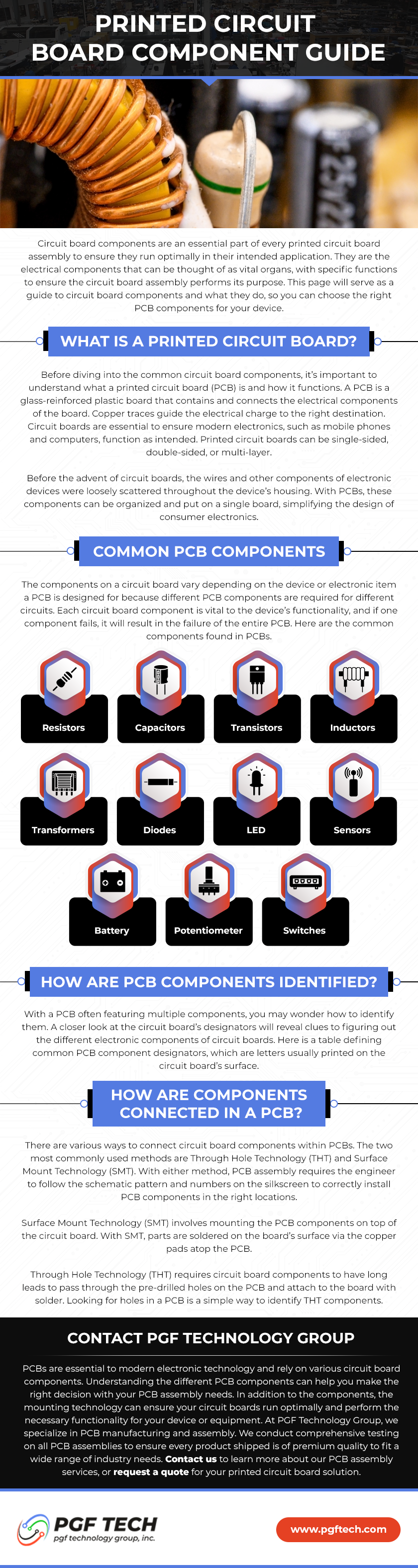
Printed Circuit Boards, or PCBs, hold a variety of functions, sizes, and industrial applications. To add electrical components to the board, PCB assemblers utilize either surface or through-hole mounting methods. PGF Technology Group prides itself on offering both PCB techniques, with optional combinations of  SMT or through-hole technologies. By staying on the edge of technology, PGF continues to further integrate surface-mounting techniques to all applicable assemblies, saving both time and money. However, although the surface mounting techniques take precedent, PGF continues to provide authentic through-hole processes to best suit customer specifications. The presence of both techniques widens the PGF market, thus utilizing either process based on the most efficient solution.

Surface Mounting

The surface mounting PCB assembly method involves mounting electrical components onto the top of the printed circuit board. With surface mount technology (SMT), electrical components are installed in a simple and timely manner. The surface-mounting technique allows ample use of both sides of the board. Surface mounting SMT technologies automate the assembly process, increasing production speed while maintaining high-quality products. The Fuji and MyData machines are the two main types of machinery used to process PCBs.

PCB Techniques Infographic

Benefits:

  • Allows for smaller PCB design, closely placed components
  • Compact and lightweight
  • Cost-effective with faster production time
  • More efficient designs with components aligned tighter together
  • More controlled manufacturing environment from automated machine technology


Through-Hole Mounting 

Through-hole mounting involves a pre-drilled hole to install and solder the electrical component to the printed circuit board. Typically used for large components, the through-hole method may also be utilized for attaching components determined incompatible with the surface mount technologies. Before SMT advanced automating technologies, the through-hole method was the main assembly practice to attach components to the board. While through-hole mounting is not as common, particularly military and aerospace industries utilize such methods to ensure durability in irregular conditions.


Benefits:

  • With components attached through the board, such PCBs offer higher strength and reliability
  • Able to endure larger amounts of external physical stressors
  • Easily replaceable and thus desirable for various testing endeavors or prototyping projects
  • Ability to withstand higher heat capacities
  • The stronger bond between the board and the electrical components allows higher power capabilities


PGF Premium Services

While offering both surface mounting and through-hole mounting techniques, PGF delivers high-quality products that meet all customer specifications promptly. Additionally, PGF offers X-Ray Evaluations and Ionograph Testing services to all customers, showcasing the company’s dedication to excellence. Learn more about the endless PGF advantages for all your PCB needs. Request a quote and experience all PGF premium services today!

LinkedIn LogoYouTube LogoTwitter LogoFacebook Logo

Question #3: CEO Success Series

   |   By  |  0 Comments

Question #3

What are some of the leadership lessons Naji Gebara has learned in his career experience? How does he incorporate those into the company’s culture?

Naji’s beginning on the shop floor broadened his inner knowledge while growing his perspective of the PGF team. Just as the assemblies became more and more complex, the insight gained by Naji continuously expanded. This hands-on experience guides him to provide leadership without empty promises but rather knowledge-based fundamentals. From this standpoint, the training process became evident in a two-step summary: (1) Give them the tools and (2) Let them dream about new ways to excel. By allowing for creativity and utilizing his leadership lessons, Naji Gebara is giving the PGF team the room to grow exponentially.

The Tools

Question #3 blog infographic

In following the first step of the PGF training process, employees can employ personal creativity and ideas. Training modules, strong leaders, and an open environment are critical to providing individuals the opportunities to grow and succeed. From project leaders to PCB floor managers, employees interact and learn with all members of PGF. After all, Naji encourages employees to reach their highest potential through a supportive work environment with personal and career-focused opportunities.

The Dream  

To promote a supportive environment amongst co-workers and leaders, Naji motivates employees to dream about new ways to excel. With plans to improve workstations, enhance employee skill sets, and integrate cutting-edge technology, the PGF company culture continues to head toward progress and success. Likewise, Naji’s journey from cable assembler to CEO demonstrates the endless growth opportunities at PGF. 

The Values

PGF’s second core value notes that employees are like family. As a small business, this understanding marks PGF as a company that has kept the family feel within a corporate structure. This family grows through job-specific teams and well-versed leaders while providing high-quality work. Additionally, Naji’s leadership lessons and family mindset lead to the other two company values. These values state that customers are the priority, and innovation is a continuous process. 

The PGF Team is a PGF Family

Above all, the leadership lessons fostered from Gebara’s personal experience shape the PGF team as a PGF family. With many PGF leaders starting with Naji over a decade ago, the PGF family is a strong and inviting group. All in all, PGF motivates employees to utilize the tools provided and express personal creativity for personal and corporate success.

LinkedIn LogoYouTube LogoTwitter LogoFacebook Logo