

Medical devices depend on flawless electrical connections. A single compromised wire harness inside an infusion pump, patient monitor, or surgical robot can mean the difference between reliable performance and a costly recall. For engineers and OEMs sourcing cable and wire harness assembly for medical applications, the stakes are uniquely high; patient safety, regulatory scrutiny, and device longevity all hinge on getting the details right.
Whether you’re designing a diagnostic imaging system, a wearable monitor, or a surgical instrument, here are seven considerations that separate a dependable harness partner from a risky gamble.
1- Regulatory Compliance and Quality Systems
Medical device manufacturing operates under a strict regulatory umbrella, and your harness assembly partner should already live inside that world. Look for a supplier certified to ISO 13485, the quality management standard specific to medical devices, alongside ISO 9001 as a baseline.
A good practice is to also look for the year next to the certification (ex. ISO 9001: 2016). This helps you ensure that a wire harness assembly company’s certifications are as up-to-date as possible.
2- Precision and Repeatability in Assembly
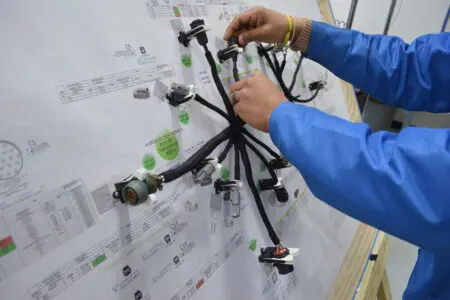
Medical devices frequently pack dense, miniaturized electronics into tight enclosures, such as handheld diagnostic tools or implantable device programmers. This demands harness assembly with tight tolerances, consistent wire routing, and connector placement that repeats exactly, unit after unit.
IPC/WHMA-A-620 is the governing standard here, covering acceptability criteria for cable and wire harness assemblies. A partner who builds to Class 3 requirements under this standard (the highest tier, reserved for high-reliability electronics) brings a level of workmanship discipline that matters enormously in medical applications where failure carries real consequences.

3- Strain Relief and Mechanical Durability
Cables inside medical equipment endure loads of physical stress: repeated flexing in a handheld ultrasound probe, vibration during patient transport, or tension every time a cart-mounted monitor gets wheeled between rooms. Without proper strain relief, solder joints crack, crimps loosen, and connectors fail long before the device’s expected lifespan is up.
Good harness design accounts for bend radius limits, service loops, and reinforced boot or grommet placement at every connection point. For equipment used in ambulances or field settings, added considerations like vibration dampening and abrasion-resistant sleeving extend usable life significantly.
4- EMI/EMC Shielding and Signal Integrity
Medical environments are electrically noisy. MRI suites, operating rooms packed with electrosurgical units, and ICUs full of monitoring equipment all generate electromagnetic interference that can corrupt sensitive signals if a harness lacks proper shielding.
Braided or foil shielding, twisted-pair configurations for differential signals, and careful grounding strategies protect signal integrity in diagnostic and monitoring devices where a corrupted reading could lead to a misdiagnosis.
5- Full Traceability and Lot Control
When a component issue surfaces after a device ships, manufacturers need to trace it back to a specific lot, operator, and production date within hours rather than weeks. Comprehensive traceability supports both regulatory compliance and rapid root-cause investigation if a field issue arises. This includes documenting wire lot numbers, connector suppliers, and assembly-line records.
This level of documentation also supports FDA recall procedures and post-market surveillance obligations, giving OEMs the paper trail they need to respond quickly and confidently to any quality event.
6- Testing and Validation Protocols
Every medical-grade harness should leave the production floor backed by rigorous electrical testing. Testing procedures should happen throughout the assembly process as opposed to only at the end. First, pull testing on crimped terminations confirms mechanical strength meets specification. Once assembled, continuity testing on cables and wire harnesses confirms every connection is sound, hipot testing verifies insulation integrity under voltage stress.
Together, these practices ensure the cable or wire harness is assembled to your specs throughout assembly rather than only testing at the end of the process.
Choosing the Right Harness Partner
Cable and wire harness assembly for medical devices carries a weight that other industries rarely match. The considerations above — compliance, materials, precision, durability, shielding, traceability, and testing — work together as a system, and a weak link in any one area puts the entire device at risk.
PGF Technology Group brings ISO 13485-certified processes, IPC/WHMA-A-620 Class 3 workmanship, and decades of experience supporting regulated industries to every cable and wire harness assembly project. Whether you’re developing a new medical device or scaling production on an existing platform, our team partners with you from prototype through full production runs.
Ready to discuss your next cable or wire harness assembly project? Contact PGF Technology Group to talk through your requirements with our team.